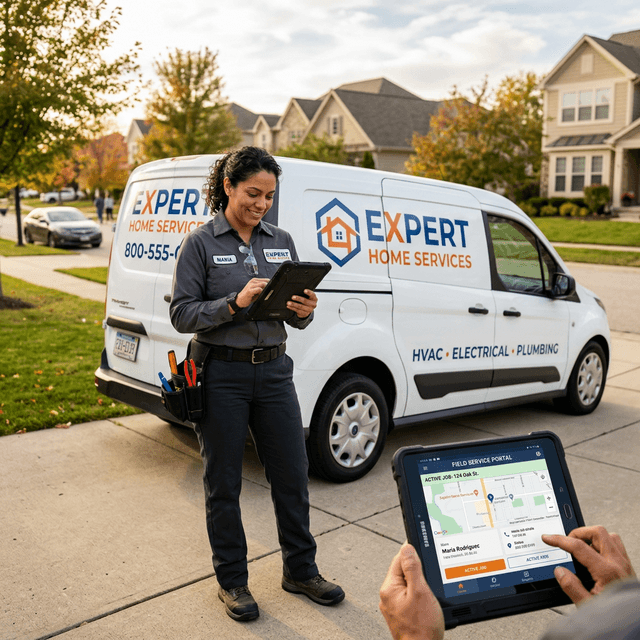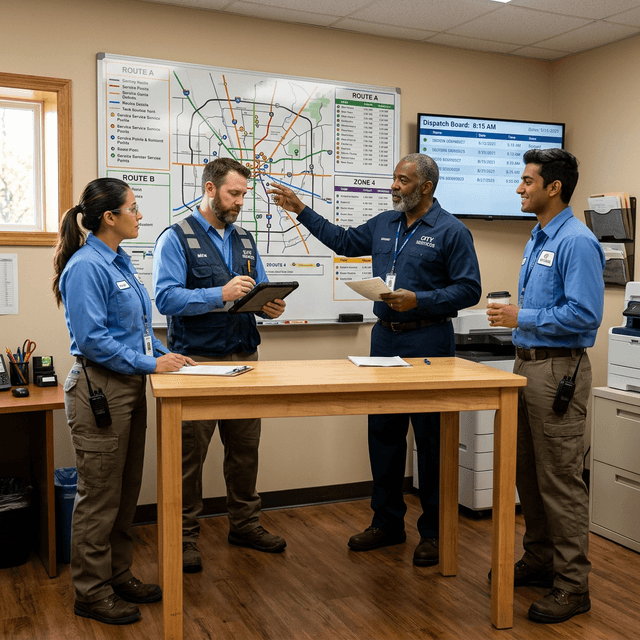
Rosie AI successfully answers phone calls, captures messages, and can schedule basic appointments. However, DispatchNode acts as a full operational dispatcher. It qualifies the customer with industry-specific diagnostic questions, checks live tech proximity, books the job, collects a Stripe deposit mid-call, and routes the nearest truck. Rosie is a virtual receptionist; DispatchNode is a virtual dispatch center.
Rosie's Market Position
Rosie has built a highly visible presence in the generalized AI phone answering space for small businesses. The platform reliably handles calls 24/7, provides basic appointment scheduling for static calendars, answers simple FAQ questions, and cleanly captures detailed text messages.
For predictable businesses such as dental offices, law firms, and real estate agencies, Rosie provides a professional first impression without incurring the significant overhead of a full-time human receptionist. The initial setup is straightforward, and the underlying conversational latency is low enough that most callers believe they are speaking with a human employee.
Rosie handles standard, low-urgency scenarios exceptionally well: business hours inquiries, static appointment requests, and digital message-taking. For non-field-service businesses, Rosie effectively solves the "nobody answered the phone" problem.
Why Service Calls Are Fundamentally Different
A dental appointment and a plumbing emergency represent fundamentally different operational interactions. The dental patient desires a convenient time slot next Thursday. The plumbing customer has raw sewage backing up into their kitchen sink immediately.
| Operational Scenario | vs | What Rosie Does (Receptionist) | What DispatchNode Does (Dispatcher) |
|---|---|---|---|
| Basic Appointment | vs | Schedules next available empty slot | Schedules while explicitly checking tech GPS proximity |
| Emergency Call | vs | Takes detailed message, promises callback | Assesses operational urgency, checks on-call schedule, dispatches truck |
| Technical Quote | vs | Provides basic boilerplate info | Calculates automated estimate based on exact job parameters |
| After-Hours Surge | vs | Takes messages for morning follow-up | Routes on-call tech immediately via push notification |
| Returning Customer | vs | Basic caller ID recognition | Full CRM history pull (previous jobs, equipment serials, notes) |
Service calls carry an acute urgency that general-purpose answering services are incapable of resolving. The caller unequivocally does not want a message taken. They demand to know that someone is coming, when they will arrive, and exactly how much the diagnostic fee will cost. Meeting this expectation requires deep architectural access to the dispatch routing system, not just a phonetic answering script.
The Revenue Case for Dispatch vs Answering
The operational math is binary. A message-taking service converts inbound calls to leads. An AI dispatcher converts inbound calls directly to booked, paid invoices at an 85-95% close rate because the transaction completes during the peak intent of the call.
Consider a standard home services company receiving 20 inbound calls per day with an average invoice ticket of $300:
That is an additional $2,400 per day—or roughly $72,000 per month—in organically captured revenue. This significant financial gap is fully explained by the conversion drop-off between "we will call you back" and "your tech will arrive at 3:30 PM today, and I have just texted you a secure deposit link."
"Rosie was great for taking messages, but we lost $8,000 in one weekend because nobody returned those messages fast enough. DispatchNode books the job live on the phone. Our weekend revenue tripled."
The Callback Decay Rate: In the trades, if a customer goes to voicemail or an answering service, 85% of them will hang up and call the next contractor on their search list. Speed to dispatch is the only metric that matters.
Choosing Based on Your Business Model
For businesses where inbound calls are purely informational (dental, legal, real estate), Rosie provides excellent structural value. Time sensitivity in these verticals is measured in days, not minutes.
For service businesses where inbound calls represent urgent, high-value, perishable opportunities, the answering service model—no matter how sophisticated the AI—leaves critical revenue on the table. The caller requires clear confirmation that help is actively driving toward their location. They need an ETA, a firm price, and a payment gateway. They require a dispatch, not a digital post-it note.
- -Do your callers need immediate technical triage?
- -Does your scheduling depend on tech location and skill set?
- -Are you losing revenue because customers call competitors while waiting for your callback?
- -Do you need to collect diagnostic fees over the phone instantly?
If you answered yes to any of these, an answering service is insufficient. You need an autonomous dispatcher.
- Sign up for DispatchNode and configure your AI agent with your services, pricing, and service areas.
- Forward your main business line to DispatchNode's AI-powered number.
- Run a 7-day parallel test: compare AI booking rates against Rosie's message-taking.
- Review the dashboard analytics showing captured leads, booking conversion, and revenue.
- Cancel Rosie and let DispatchNode handle all calls with full dispatch capability.
Platform Architecture Comparison
| Capability | Rosie | DispatchNode |
|---|---|---|
| AI Voice Agent | Not included | Built-in, 24/7 |
| Automated Dispatch | Manual or semi-auto | Fully autonomous |
| Real-Time GPS Tracking | Basic | Advanced with geofencing |
| Industry-Specific AI | Generic | Trained per vertical |
| Pricing Model | Per-seat licensing | Flat-rate SaaS |
| Setup Time | Days to weeks | Under 24 hours |
The SBA (Small Business Administration) recommends that service businesses evaluate software platforms on total cost of ownership, not just monthly subscription fees. Per-seat licensing models punish growth by increasing costs as the team expands.
Migration Workflow
The migration process is designed to eliminate any service disruption. Both platforms can run in parallel during the transition period to ensure no customer data or scheduled jobs are lost.
Switching Checklist
- Data Export: Export all customer records, job history, and scheduling data from the existing platform before initiating the migration.
- Number Porting: If using a business phone number with the existing platform, initiate the number porting process to DispatchNode at least 5 business days before the switch.
- Team Training: Schedule a 1-hour training session for all dispatchers and crew on the new mobile app interface.
- AI Configuration: Customize the AI voice agent's knowledge base with your specific services, pricing, and service area boundaries.
- Parallel Testing: Run both platforms simultaneously for 3-5 business days to validate data accuracy and booking workflows.
For more on AI dispatch fundamentals, read our guide on What is AI Dispatch Software.
Why Industry-Specific AI Vocabulary Matters
Rosie and similar generic AI receptionists operate on generalized language processing models. They are trained on vast, unfiltered datasets of general human conversation. While this allows them to sound conversational, they lack the highly specific vocabulary required for complex service dispatching.
If a generic AI is asked about a "contactor," it might assume the caller is talking about a person (a contact). In the HVAC industry, a "contactor" is a specific, high-voltage electrical relay.
This lack of a structured industry vocabulary causes generic AI tools to struggle when your tech or a knowledgeable homeowner attempts to convey technical diagnostics over the phone. The AI may misinterpret the data, leading to logistical errors.
DispatchNode's AI language processor is built on deep, industry-specific vocabulary models. The model is specifically trained on millions of data points originating from the plumbing, HVAC, electrical, and heavy logistics sectors.
When a caller says, "My condenser fan is short-cycling, and I think the run capacitor is blown," the DispatchNode AI comprehends the exact mechanical failure. It correlates the symptoms with the likely required repair, understands that this is a high-priority "No Cool" emergency, and identifies the correct technician.
This technical fluency is the primary differentiator between a conversational assistant and a professional-grade operational asset.
Eliminating Triage Latency
In genuine emergency scenarios—such as a plumbing leak or a power failure—every second of latency is costly and increases the potential for property damage. Generic AI answering services are typically not engineered for high-stakes emergency triage.
They often follow a rigid, linear conversational script, forcing the caller to endure standard data collection before addressing the crisis.
DispatchNode's architecture is specifically engineered to eliminate triage delays. The AI utilizes advanced sentiment analysis to detect panic or urgency in the caller's voice within the first two seconds of the interaction.
If the AI detects an acute emergency state, it overrides its standard data-collection script. It skips non-essential questions and jumps straight to crisis stabilization: "I understand this is an emergency. What is the address of the flooding?"
As soon as the address is provided, the AI simultaneously executes spatial queries to identify the closest available technician. "I have a truck three miles away. To stop the damage immediately, do you know where your main water shutoff valve is located?"
Integration and Caller Experience
The integration architecture determines which downstream operations each platform can automate. Rosie AI focuses on call handling and integrates with basic CRM tools to push lead data into your existing customer database.
DispatchNode integrates with CRM, scheduling, payment processing, and fleet management platforms simultaneously, meaning a single customer conversation can trigger a chain of automated actions: create a CRM record, book an appointment, collect a deposit, assign a tech, and send the customer a confirmation with the tech's name and estimated arrival time.
Rosie produces a genuinely impressive conversational AI that handles small talk, manages interruptions, and maintains context throughout extended calls. These conversational qualities are important for creating a positive caller experience, and Rosie excels in this dimension.
The gap between Rosie and DispatchNode emerges in the operational depth behind the conversation. Rosie's AI conducts a warm, professional conversation and captures the caller's information for later follow-up.
DispatchNode's AI conducts a similarly warm conversation while simultaneously querying the scheduling database, calculating pricing, verifying service area coverage, and processing a booking.
The caller experience may feel similar from the outside, but the operational outcome is fundamentally different: a Rosie call produces a lead that requires manual action, while a DispatchNode call produces a confirmed, dispatched appointment that requires no manual intervention.
Keep reading:
- DispatchNode vs ServiceAgent: Which AI Voice Platform Actually Dispatches?
- Multilingual AI Agents for Service Businesses
→ See the full rosie vs DispatchNode side-by-side comparison table →