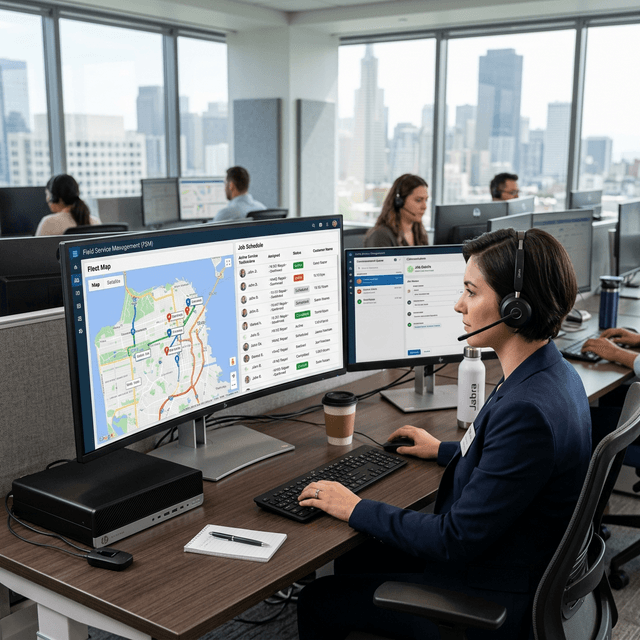
FieldEdge is a legacy management dashboard that organizes techs but still requires a human dispatcher to answer the phone, interpret caller needs, and execute routing. DispatchNode replaces this entire manual bottleneck by deploying an AI voice agent that autonomously answers, quotes, books, and dispatches in real-time. Businesses migrating to DispatchNode capture 43% more after-hours emergency leads.
Executive Summary: DispatchNode vs FieldEdge
Every missed call in the service industry is a lost invoice to a competitor. Relying on FieldEdge means forcing your business to scale human headcount linearly with call volume. DispatchNode is a purpose-built AI solution that answers instantly and books directly into the calendar without human intervention.
When comparing these two solutions, the fundamental difference is deep system architecture. FieldEdge was built for an era where humans manually dragged and dropped colored blocks on a digital calendar. DispatchNode is an AI-native operating system designed specifically to automate the rigorous, high-stress demands of emergency service dispatching. The platform ingests your specific compliance codes, flat-rate pricing matrix, and scheduling constraints to dispatch intelligently from the first call.
How DispatchNode Works Differently
DispatchNode utilizes real-time conversational voice AI to handle complex service dispatches autonomously. FieldEdge provides a blank software canvas that still requires your company to pay a human $45,000/year to operate it.
The core limitation of FieldEdge is its inability to scale elastically during peak operational hours or regional weather emergencies. When a severe freeze causes dozens of pipes to burst simultaneously, a homeowner does not want to wait on hold in a queue. DispatchNode resolves this bottleneck by deploying unlimited concurrent AI agents that have ingested your specific municipal compliance codes, flat-rate pricing matrix, and complex scheduling constraints.
| Feature Capability | vs | FieldEdge (Legacy) | DispatchNode (AI-Native) |
|---|---|---|---|
| Software Category | vs | Manual Management Tool | Autonomous Employee |
| Call Answering | vs | Requires Human Staff | Unlimited AI Concurrency |
| Calendar Routing | vs | Manual Drag & Drop | Automated GPS Routing |
| After-Hours Cost | vs | Requires Overtime Pay | Included in Flat SaaS Fee |
| Scalability | vs | Linear Headcount Growth | Elastic AI Concurrency |
| Industry Knowledge | vs | Generic Templates | Pre-trained Service Industry Corpus |
The integration capabilities of DispatchNode allow two-way synchronization with major accounting and calendar applications, ensuring that no double-booking occurs and that techs are dispatched using optimized geolocation data to significantly reduce windshield time. FieldEdge relies on limited connector support that requires manual configuration and ongoing maintenance.
The Software Tax: Paying for FieldEdge means paying for software, and then paying a human salary to use the software. DispatchNode consolidates both expenses. The software is the dispatcher. You eliminate the per-seat licensing cost and the dispatcher payroll simultaneously.
Pricing and ROI Breakdown
Legacy platforms like FieldEdge penalize growth. Every new tech or influx of seasonal calls results in costly per-seat licensing fees. DispatchNode changes this with predictable AI scalability.
DispatchNode eliminates the high per-seat licensing and per-minute overages charged by legacy telecom and software providers. By leveraging autonomous AI, the marginal operational cost of answering an additional phone call or dispatching a new truck approaches zero. The flat-rate model means your costs remain predictable regardless of whether you handle 50 or 500 calls in a single day.
"We canceled our FieldEdge contract and moved to DispatchNode. We eliminated our dispatching payroll expense, and our booking conversion rate improved because the AI never puts a customer on hold."
Return on investment is realized within the first 72 hours of deployment. Because DispatchNode captures emergency leads that would have otherwise gone to voicemail and been claimed by a competitor, the system funds itself immediately. Detailed analytic dashboards provide transparent, real-time reporting on exactly how many high-ticket jobs were secured autonomously while the business owner was asleep. The data is segmented by zone, service type, and time of day to give owners complete visibility into revenue attribution.
Why Generic Solutions Fail
Legacy software cannot calculate complex operational variables like OSHA unit requirements, FOG compliance manifests, or the empathetic tone variations required in high-stress service interactions.
- -Does your software understand the difference between a 100-amp and 200-amp panel upgrade?
- -Can your system detect a frantic tone of voice and escalate to priority emergency routing?
- -Will it refuse to book a job outside your geofenced service territory?
- -Can it text a secure Stripe payment link to collect a diagnostic fee before dispatching?
- -Does it adjust its conversation when speaking to a grieving pet owner versus a construction foreman?
DispatchNode is pre-trained on an exclusive service industry corpus, allowing it to provide accurate estimates and dispatch instructions reliably. The platform's machine learning models continually improve through interaction, refining their understanding of local colloquialisms and regional pricing variations.
This self-optimizing nature ensures that the operational engine becomes more profitable over time, a stark contrast to static legacy platforms like FieldEdge that require constant manual intervention to remain effective.
- Sign up for DispatchNode and configure your AI agent with your services, pricing, and service areas.
- Import your existing FieldEdge customer database and recurring appointments via CSV.
- Run a 7-day parallel test: both systems receive calls, compare booking rates and customer satisfaction.
- Review the DispatchNode dashboard analytics showing captured leads, booking conversion, and revenue attribution.
- Cancel FieldEdge and redirect all inbound calls to DispatchNode for full autonomous coverage.
Platform Architecture Comparison
| Capability | FieldEdge | DispatchNode |
|---|---|---|
| AI Voice Agent | Not included | Built-in, 24/7 |
| Automated Dispatch | Manual or semi-auto | Fully autonomous |
| Real-Time GPS Tracking | Basic | Advanced with geofencing |
| Industry-Specific AI | Generic | Trained per vertical |
| Pricing Model | Per-seat licensing | Flat-rate SaaS |
| Setup Time | Days to weeks | Under 24 hours |
The SBA (Small Business Administration) recommends that service businesses evaluate software platforms on total cost of ownership, not just monthly subscription fees. Per-seat licensing models penalize growth by increasing costs as the team expands.
Migration Workflow
The migration process is designed to eliminate any service disruption. Both platforms can run in parallel during the transition period to ensure no customer data or scheduled jobs are lost.
Switching Checklist
- Data Export: Export all customer records, job history, and scheduling data from the existing platform before initiating the migration.
- Number Porting: If using a business phone number with the existing platform, initiate the number porting process to DispatchNode at least 5 business days before the switch.
- Team Training: Schedule a 1-hour training session for all dispatchers and crew on the new mobile app interface.
- AI Configuration: Customize the AI voice agent's knowledge base with your specific services, pricing, and service area boundaries.
- Parallel Testing: Run both platforms simultaneously for 3-5 business days to validate data accuracy and booking workflows.
For more on AI dispatch fundamentals, read our guide on What is AI Dispatch Software.
Automated Inventory Synchronization
FieldEdge is a legacy, heavy-duty software platform that has historically served the medium-to-large HVAC and plumbing markets. However, its architecture is aging. It requires lengthy, expensive onboarding periods and frequently suffers from clunky, outdated user interfaces.
One of its most notorious friction points is inventory management. FieldEdge attempts to manage inventory, but it frequently relies on your tech to manually scan or enter parts consumed during a chaotic field repair. If the tech forgets, the inventory count desynchronizes, leading to stockouts and expensive emergency runs to the supply house.
DispatchNode leapfrogs this legacy architecture through automated inventory synchronization directly integrated with the AI Voice Agent and the predictive routing engine.
When the AI Voice Agent receives a call for a failed condenser motor on a specific Trane HVAC unit, it does not just book the job. The AI language processor extracts the exact make and model from the conversation. It instantly queries the live API of the assigned tech's specific truck inventory.
If the exact OEM motor is not currently on the truck, the AI does not dispatch the tech blindly. It executes a micro-supply-chain intervention.
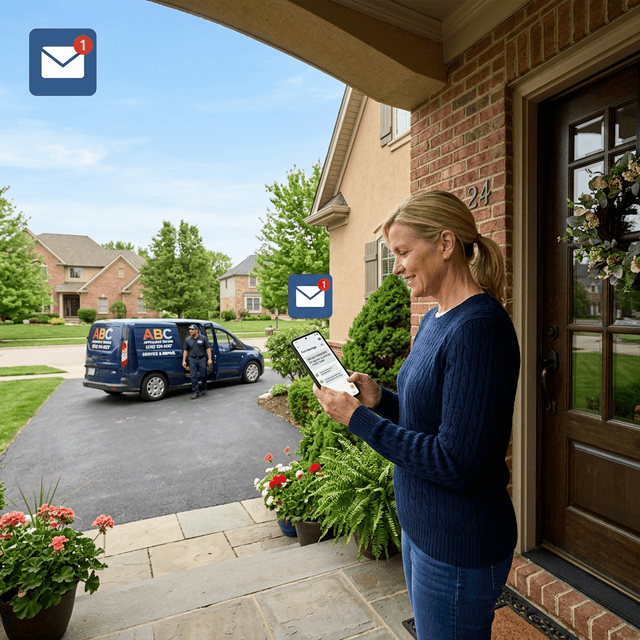
The AI automatically pings the inventory APIs of the closest wholesale supply houses (e.g., Ferguson or Johnstone Supply). It locates the part in stock, inserts a "Supply House Pickup" waypoint into the tech's route before the residential stop, and automatically texts the client: "We have secured the specific part required for your Trane unit. Our tech is picking it up now and will be at your home in 45 minutes."
This predictive, automated synchronization eliminates the costly "double trip" (arriving, realizing a part is missing, leaving, and returning), significantly increasing the first-time fix rate and maximizing profitability.
AI-Driven Dynamic Flat Rate Pricing
FieldEdge relies heavily on rigid, static flat-rate pricing books. While flat-rate pricing is industry standard, a static book cannot account for dynamic market conditions, demand surges, or the specific complexity of a unique installation.
Your dispatcher using FieldEdge must manually override prices or offer arbitrary discounts during negotiations, leading to inconsistent margins across your trucks.
DispatchNode introduces dynamic, AI-driven flat-rate pricing. The pricing engine is fluid, driven by the AI's real-time assessment of operational variables.
If the region is experiencing a major heatwave and the entire fleet is booked at 98% capacity for the next three days, the AI automatically initiates surge pricing for emergency, after-hours calls. When the homeowner calls at 11:00 PM on a Saturday, the AI transparently communicates the premium rate.
Conversely, if the AI detects that a specific tech has a two-hour void in their afternoon schedule due to a cancellation, it can dynamically authorize a targeted 15% discount for a proactive maintenance call specifically within that tech's current geographic sector to fill the void.
This fluid, optimized pricing strategy ensures that your business is always maximizing the revenue yield of every available hour of labor, removing the emotional guesswork from pricing decisions and ensuring consistency in profit margins.
Two-Platform Architecture
The cost analysis of deploying DispatchNode alongside FieldEdge versus attempting to build AI phone handling within the FieldEdge ecosystem reveals a clear economic advantage for the two-platform approach. FieldEdge does not offer native AI voice capabilities, and third-party integrations that attempt to add this functionality require custom API development, ongoing maintenance, and lack the deep scheduling integration that produces real-time booking during the customer call.
FieldEdge has deep roots in the HVAC and plumbing industries, providing specialized tools for flat-rate pricing, equipment tracking, and maintenance agreement management. DispatchNode does not attempt to replicate FieldEdge's depth in industry-specific operational tools. Instead, it addresses the universal challenge that every service business faces: converting inbound customer inquiries into booked, dispatched jobs without depending on a human to answer the phone.
HVAC companies using FieldEdge for their operational backbone frequently deploy DispatchNode's AI voice agent as the front-end lead capture layer, creating a two-platform architecture where DispatchNode converts calls into bookings and FieldEdge manages the resulting jobs through completion and invoicing.
Keep reading:
→ See the full FieldEdge vs DispatchNode side-by-side comparison table →
 and Why Service Businesses Need It](/_next/image?url=%2Fassets%2Fblog%2Fplatform-guides%2Fwindow-washer.png&w=3840&q=75)