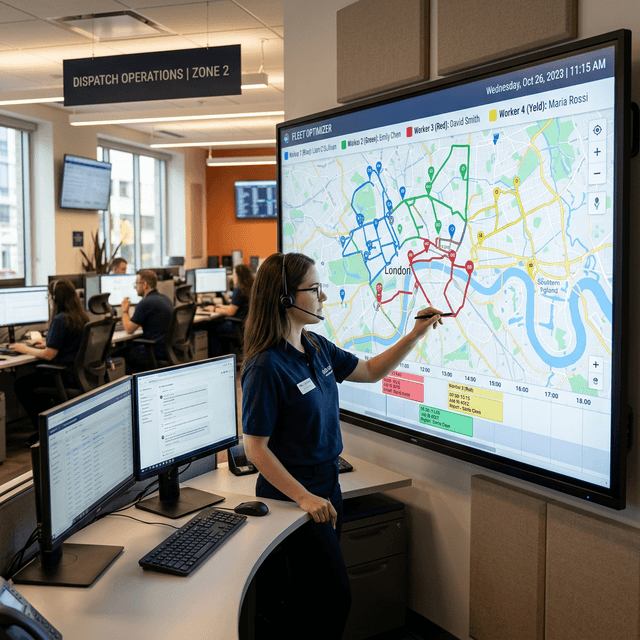
Business owners lose thousands weekly by relying on legacy phone trees that frustrate customers and miss bookings. This manual inefficiency exposes businesses to significant revenue leaks during peak hours. DispatchNode eliminates this risk with a native AI Operating System that autonomously manages dispatching, capturing every inbound opportunity instantly.
Not all AI voice agents are created equal. Just like autonomous driving ranges from cruise control (Level 1) to fully self-driving cars (Level 5), AI dispatching has a maturity curve. Legacy scheduling platforms bolt on third-party tools that get stuck at Level 1, while native AI architectures like DispatchNode operate at Level 3, actively managing complex orchestrations and saving businesses thousands in overhead.
The Automation Scale: Levels 0 to 5
Bottom Line Up Front: AI maturity for service businesses spans a continuous spectrum. Legacy scheduling platforms are currently generating major buzz by bolting on Level 1 answering machines, but jumping to higher tiers is very difficult for them due to their rigid legacy systems. DispatchNode, conversely, was built from day one to be an AI Operating System with Level 5 ambitions.
To bring clarity to this space, we evaluate AI voice capability on a scale inspired by autonomous driving levels.
Level 0: Fully Manual & Legacy IVR
The Reality: The baseline of the industry. This is a human dispatcher manning a multi-line desk phone, attempting to coordinate trucks on a whiteboard or a clunky calendar, while simultaneously dealing with frustrated customers navigating an outdated "Press 1 for Sales, Press 2 for Service" Interactive Voice Response (IVR) tree. The Capability: Non-existent. Customers who get sent to voicemail hang up and call the next competitor. Dispatchers are stressed, reacting to chaos rather than orchestrating the business. The Economics: Significant revenue leakage. Every missed call during a busy surge is a lost $500–$2,000 job. Staff are overworked, and payroll is losing money to handle simple FAQ questions.
Level 1: The Modern Answering Machine (Basic FAQ & Intake)
The Buzz: This is the low-hanging fruit where the majority of legacy scheduling platforms are currently scrambling. They are bolting third-party voice tools onto their existing software to answer the phone. The Capability: The AI acts as an interactive FAQ. It can answer basic questions ("Do you service my zip code?"), take a message, transcribe an inbound lead, and perhaps text the customer a link. Use Cases: After-hours answering service, basic lead capture. Corner Cases: If a customer asks a complex question about a specific part, the AI hallucinates or fails to parse the context, dropping the ball. The Economics: It replaces a free voicemail box or a cheap $300/month answering service. Level 1 is easy to justify financially because rescuing just one or two missed calls pays for the tool. However, it does not replace headcount. It simply catches the overflow.
Level 2: The Interactive Assistant (Shadow Mode)
The Capability: The AI connects to read-only systems and starts assisting the human dispatcher. It can quote your price book, provide basic service information, and draft a response or schedule block. The Friction (The 80/20 Rule): This is where the 80/20 rule actually kicks in. The AI can handle 80% of the conversation effortlessly, but it still requires a human to step in for the final 20%—evaluating schedule constraints and manually finalizing the booking. Because legacy software lacks a native AI state machine, crossing the gap from Level 1 to Level 2 requires brittle integrations that often break under real-world pressure. Shadow Mode: In Level 2, the AI operates in "Shadow Mode"—it suggests actions, but a human must explicitly approve them before they are executed. This builds trust but retains the human bottleneck. Corner Cases: The AI proposes a time slot that looks open but violates a complex geographic routing rule. The human must catch this and override it.
Level 3: Autonomous Orchestration (Headcount Replacement)
The Capability: This is where things shift to live execution. The AI gains deep read/write access. It reads complex multi-resource constraints (e.g., "Do we have a pump truck and an available driver on Tuesday?"), negotiates availability dynamically, and fully dispatches the job without human intervention. Use Cases: End-to-end booking of standard service calls, emergency dispatch routing based on live truck locations. Corner Cases: The system must gracefully handle edge cases like a customer attempting to book a service outside the normal operating area or requesting a highly specialized repair that requires a specific part not typically stocked. The AI hands off to a human only when strict constraints are violated. The Economics: Because the AI can handle the call from greeting to completed booking, it replaces dispatch headcount. It doesn't just catch overflow; it serves as a fully capable digital dispatcher, answering the phone professionally at 2 AM on a Sunday and securing revenue at near-zero marginal labor cost. DispatchNode natively operates at this level today.
Level 4: The Self-Calibrating Fleet
The Capability: Moving from reactive to proactive. The AI anticipates demand, automatically reshuffles the entire company schedule based on live traffic or weather forecasts, and surge-prices high-demand areas dynamically. It actively works to compress routes and maximize truck efficiency before the first truck ever starts its engine. Use Cases: Proactive re-routing during a snowstorm, dynamic pricing during a heatwave when HVAC calls spike. Corner Cases: Balancing predictive re-routing against customer commitments. If the AI moves an appointment to optimize a route, it must seamlessly negotiate the change with the customer without causing frustration.
Level 5: The CEO-Level Oracle
The Capability: True autonomy. The AI doesn't just dispatch—it runs the logistics of the business. It possesses real-time knowledge across operational bottlenecks, accounting, finance, and fleet maintenance. The Economics: It significantly reduces total operational costs, achieves near-perfect efficiency across the board, and provides the owner with a complete view of the company. It allows business owners to step fully out of the daily logistics loop. Because DispatchNode was built natively as an AI Operating System, achieving Level 5 autonomy is the foundational North Star of our architecture.
Building Trust Gradually
A major hurdle for businesses adopting AI is the transition of trust. You cannot immediately hand the keys of your multi-million dollar fleet to a machine. DispatchNode solves this through a framework we call Smart Constraint Relaxation.
This framework allows business owners to define strict boundaries (constraints) that the AI cannot cross. As the AI proves its competence in Shadow Mode (Level 2), the owner can slowly "relax" these constraints, moving toward true autonomy (Level 3+).
- Tight Constraints (Level 2): "The AI can only book standard maintenance calls within a 10-mile radius, and must send a slack message for human approval before committing."
- Relaxed Constraints (Level 3): "The AI can book any service call within a 50-mile radius, automatically adjust the schedule, and commit without human review, provided the profit margin remains above 45%."
By controlling the relaxation of constraints—geofences, profit margins, job types, and overtime rules—businesses can safely scale their AI adoption without risking serious operational failures.
The DispatchNode Hybrid Architecture
The reality of running a service business is that different jobs require different levels of autonomy. An emergency pipe burst at 2 AM requires a Level 3 response to secure the job instantly. A complex commercial installation quote might require a Level 2 Shadow Mode approach where the AI gathers specs but a human engineer finalizes the bid.
DispatchNode’s Hybrid Architecture seamlessly handles this spectrum in real-time. The Autonomy Engine allows you to configure specific workflows to operate at different levels simultaneously.
Shadow Mode vs. Live Execution
Our architecture explicitly separates planning from execution. In Shadow Mode (Level 2), the AI drafts the perfect response, calculates the optimal route, and queues the booking—but pauses for a single click of human approval. This bridges the trust gap.
In Live Execution (Level 3), the AI leverages our scheduling engine to guarantee that its actions comply with all business rules, allowing it to execute the booking instantly and confidently.
The "Bolt-On" Tax: Why Incumbents Are Stuck at Level 1
Bottom Line Up Front: Legacy scheduling platforms suffer a permanent Level 1 ceiling due to the latency of third-party API bridging. DispatchNode's native AI core eliminates the 1,500ms delay inherent to these bolt-on architectures, changing the economics of running a service business.
The home service software market is dominated by large legacy platforms. Because these platforms were built a decade ago on rigid, pre-AI relational databases, they cannot easily integrate real-time LLM reasoning into their core scheduling algorithms.
To claim "AI capabilities," these incumbents resort to bolting on third-party voice tools.

This creates a fundamental architectural ceiling:
Comparing Architecture
| Capability Feature | Legacy CRM + Bolt-On Tool (Level 1) | DispatchNode Native AI (Level 3) |
|---|---|---|
| Response Latency | High (>1,500ms API delays) | Near-Zero (Native State Machine) |
| Schedule Awareness | Read-Only or Brittle Sync | Real-Time Accuracy |
| Rerouting Logic | Impossible (Requires Human) | Autonomous (Solver Engine) |
| Total Cost of Ownership | Double Billing (CRM + AI Minutes) | Consolidated Platform Pricing |
The Consolidated Advantage: Because DispatchNode was built from day one as an AI Operating System, the LLM and the scheduling database are intrinsically linked. This eliminates the "bolt-on tax." You get a Level 3 autonomous dispatcher natively consolidated with your scheduling platform, significantly reducing your overall software expenditure while delivering significantly better operational capability.
The Roadmap: Achieving Level 4 and Level 5
While DispatchNode's Level 3 architecture already provides a strong competitive advantage, our engineering roadmap is heavily focused on pushing into Levels 4 and 5.
Reaching Level 4: Autonomous Tuning
To achieve Level 4, an AI must move from orchestration to prediction. The DispatchNode scheduling engine is currently being upgraded to ingest historical weather data, traffic patterns, and seasonal demand curves. In the near future, the AI will not just book the most efficient slot—it will proactively surge pricing in specific regions based on predicted rainstorms, and automatically re-cluster your crew to minimize transit time before the demand even materializes.
Reaching Level 5: Zero-Touch Scale
Level 5 autonomy requires the AI to handle 99.99% of edge cases. This means surviving the chaotic reality of service work: a customer changing their address while the truck is en route, a tech's van breaking down, or a homeowner disputing a nuanced invoice item over the phone.
Achieving Level 5 requires giving the AI a large, multi-modal context window. By integrating visual data and equipping the agent with deeper negotiation capabilities, DispatchNode aims to create a truly essential digital employee—a system that scales without limits and handles the chaos of the physical world with confidence.
How to Upgrade Your Dispatching
Moving to a Level 3 native architecture requires a clean break from bolt-on mentalities.
- Evaluate Current Bottlenecks: Identify how many calls require human intervention due to API sync delays between your phone tool and CRM.
- Consolidate Architecture: Migrate to a native AI Operating System like DispatchNode that merges the telecom layer with the scheduling solver.
- Define Edge Constraints: Set your fallback parameters so the AI knows exactly when to escalate a complex logistical failure to your human dispatchers.
Grade Your Dispatch Operations in 15 Minutes
A 36-point checklist covering scheduling conflicts, dispatch tracking, and after-hours coverage. Find the leaky buckets costing you revenue every week.

 and Why Service Businesses Need It](/_next/image?url=%2Fassets%2Fblog%2Fplatform-guides%2Fwindow-washer.png&w=3840&q=75)